Africa will produce new variants of Christianity and Islam. Furthermore, many African regions have not been Christian or Muslim for very long, not by historical standards. That might boost the chances of innovation, since to them it is not a very fixed doctrine.
— Read on marginalrevolution.com/marginalrevolution/2025/07/three-scenarios-for-the-emergence-of-new-religious-doctrine.html
Basement Whatever
Escape the algorithm
aging ai algorithm aliens Art builder Chicago cities community corporation dnd enshittification future games governance happiness history hollywood humanity information Internet learning magic management media movie Movies music organization perspective predictions privacy project reading reality social social media sports technology travel ttrpg USA wealth work writing
about
-
-
While the past midlife crisis model focused on breaking down confining bonds, chipping away at that adult façade to return to the fountain of youth, Xers are still in full construction mode. “I’ve made a list – it’s the ‘do-better’ list,” Leslie Mann’s character tells her husband in Judd Apatow’s flawed but occasionally insightful “This Is 40.” Her list, of course, is exhausting: A far cry from Peter Sellers’ laced-up, nearly calcified lawyer, chronically encased in his business suit, fighting to break out of convention, Debbie seems like a woman without a past, chronically intent on self-reinvention. She’s not looking back at what she lost – she’s barely gotten started.
More at the link.
-
“People want a fair deal from someone they like.”
When questioned about his actions to get people to like him, he simply says, “I tell them that I like them.”
— Read on fs.blog/joe-girard/ -
You have to identify with this past of yours, and you have to find some way to make it make you stronger. If college was a quicksand pit of despair then you have to accept that and find some way to be empowered by it.
-
the U.S. is in the middle of a great shift — in the 19th and 20th centuries, high class in America was defined as “anything French”, while in the 21st century it’s defined as “anything Japanese”.
Apparently the Japanese don’t realize it yet? More here.
-
NASA’s been clear that it doesn’t intend to replace the space station.
Instead, the agency wants to shift from landlord to tenant, purchasing space station services from private players rather than running a facility of its own. It’s betting the private space industry can help drive down costs and accelerate innovation.
— Read on singularityhub.com/2025/12/26/the-era-of-private-space-stations-launches-in-2026/ -
the way we think about the world—made of separate, clearly labeled “things” that you can depend on to “be themselves”—is an illusion. The universe is governed by physical laws that are all about movement, forces, warping, and never about peacefully existing in a room
— Read on planktonvalhalla.com/20251204-purpose-from-first-principles/ -
What do you notice about this reconstruction? That’s right, it looks awful. In the eyes of modern viewers, at least, the addition of this matte, heavily saturated color has turned a really good work of art into a really bad one.
— Read on worksinprogress.co/issue/were-classical-statues-painted-horribly/ -
The head tax is bad tax policy dressed up as soak-the-rich populism. It’s the kind of thing that sounds good in a City Council speech, but creates real harm for the workers it’s supposed to help. If we want to find more revenues to close our budget gap, we have better options5, and we should focus on them. Chicago tried this before, decided it was a mistake, and eliminated it. We shouldn’t make the same mistake twice.
-
Imagine you could interview thousands of educated individuals from 1913—readers of newspapers, novels, and political treatises—about their views on peace, progress, gender roles, or empire. Not just survey them with preset questions, but engage in open-ended dialogue, probe their assumptions, and explore the boundaries of thought in that moment. This is what time-locked language models make possible. Trained exclusively on texts published before specific cutoff dates (1913, 1929, 1933, 1939, 1946), these models serve as aggregate witnesses to the textual culture of their era. They cannot access information from after their cutoff date because that information literally does not exist in their training data.
-
Oddly, today’s sweet plum pudding hails from a meatier dish. As Maggie Black writes in History Today, the dish that eventually evolved into plum pudding originally contained preserved, sweetened meat “pyes” and boiled “pottage” (that is, vegetables) and was enjoyed in Britain as early as Roman times.
— Read on www.smithsonianmag.com/smart-news/brief-history-figgy-pudding-180957600/ -
This morning, I woke up in a supremely comfortable bed, knowing there would be no deadly predators or pests to eat or infect me. With cheap soaps and pristine, hot water, I became cleaner in five minutes than was possible for any human—no matter how wealthy—in the past.
With a flick of a switch, I conjured hot coffee into existence with a taste and quality that could not have been summoned by any empire or fleet previously. In a safe car that could rapidly whisk me to another country in a few hours—by driving onto a train that literally travels under the ocean—I typed a few keystrokes on a magic device that allowed me to listen to virtually any music recorded, anywhere on the planet, in the last century or so.
-
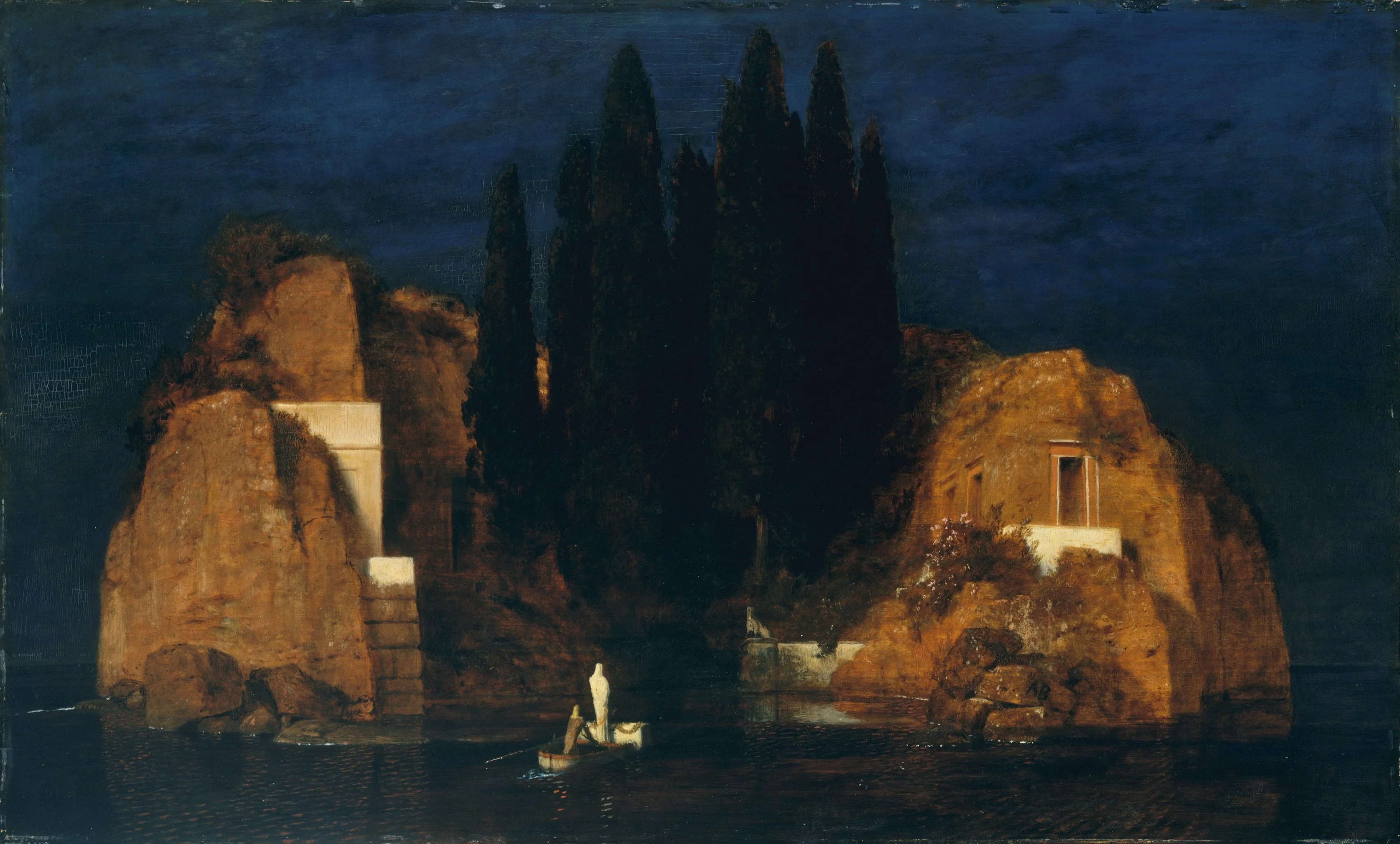
The Isle of the Dead, Arnold Bocklin It was the opinion of the Symbolists, and Bocklin in particular that the purpose of art was to reveal through the use of a language no longer logical, but from “other” reality that hides behind that immediately perceptible with careful use of “symbols.”
From Arnold Bocklin, 60 Paintings
-
“My father says that almost the whole world is asleep. Everybody you know. Everybody you see. Everybody you talk to. He says that only a few people are awake, and they live in a state of constant, total amazement.”
— Read on www.rogerebert.com/features/bright-walldark-room-august-2014-well-jump-and-well-see-by-chad-perman -
On the Road is a terrible book about terrible people. Jack Kerouac and his terrible friends drive across the US about seven zillion times for no particular reason, getting in car accidents and stealing stuff and screwing women whom they promise to marry and then don’t.
But this is supposed to be okay, because they are visionaries. Their vision is to use the words “holy”, “ecstatic”, and “angelic” at least three times to describe every object between Toledo and Bakersfield. They don’t pass a barn, they pass a holy vision of a barn, a barn such as there must have been when the world was young, a barn whose angelic red and beatific white send them into mad ecstasies. They don’t almost hit a cow, they almost hit a holy primordial cow, the cow of all the earth, the cow whose dreamlike ecstatic mooing brings them to the brink of a rebirth such as no one has ever known.
— Read on slatestarcodex.com/2014/12/02/book-review-on-the-road/ -
10. The data center buildout reaches 3.5% of US GDP in 2026.
The scale of investment mirrors the historical expansion of the railroads. The only factor that slows overall building is perceived risk within the credit market, particularly in the private credit market. The massive growth in that asset class suddenly shows strains of increasing default rates, creating a potential bottleneck for the most capital-intensive infrastructure projects.
— Read on tomtunguz.com/2026-predictions/ -
Despite Neal’s reputation as a frenetic hipster, “I just realized that there weren’t that many trips,” Carolyn said. “It sounds as though they were doing this all the time. Half of them were coming home again — people don’t realize that Jack was going home and Neal was coming home. There weren’t that many anyhow…Jack took a trip once a year and Neal would take quickies here and there. But we had a very settled home-life for ten years.”
— Read on www.emptymirrorbooks.com/beat/carolyn-cassady-interview

