One-bedroom units in the building average $3,500— except two of them, subject to the city’s rent-stabilization laws, which hold rents below $900 per month.
As a result, both units have been allowed to fall into disrepair, because the cost of restoring them to habitability is greater than what they’d generate in rent.
Basement Whatever
Escape the algorithm
aging ai algorithm aliens Art builder Chicago cities community corporation dnd enshittification future games governance happiness history hollywood humanity information Internet learning magic management media movie Movies music organization perspective predictions privacy project reading reality social social media sports technology travel ttrpg USA wealth work writing
about
-
-
Pliny the Elder, who in his Natural History, completed in 77 AD, commented that the Empire’s legionaries had not yet extended knowledge of the island of Britain beyond the neighbourhood of the Caledonian Forest
— Read on www.linkedin.com/pulse/mythical-great-wood-caledon-part-1-origins-richard-oram-khkge -
In my (extremely biased) opinion, the most stylish people on earth work at Fluevog.1 Unlike, say, Aritzia, you can walk into a store and never predict how the employees are going to be dressed. It’s a brand that celebrates individuality to the point where you’re allowed to wear whatever you want, as long as the look is totally your own. One day, I came across a video interview with an employee at their New York City store, Madeline Kevelson. After a brief scroll of her Instagram, @spiltmlk, I was smitten by her complicated, historical outfits that seem to exist outside of time.
— Read on freakpalace.substack.com/p/i-found-the-best-dressed-person-in
-
One of Diablo 4’s most significant technical changes is its fully connected overworld. Instead of isolated zones, players move through environments that update continuously. Enemy density, weather changes, public events and world boss timers are all managed through cloud coordination. As clients request updates, servers adjust local states to reflect global conditions.
The setup reduces the traditional boundaries seen in older ARPGs. It requires fast, consistent communication between server clusters and player devices. When too many events occur simultaneously or the server load spikes, players notice it immediately through latency or ‘rubber-banding’. Diablo 4’s smoothness during crowded encounters is largely a result of intelligent distribution of compute processes in multiple data centres.
— Read on www.cloudcomputing-news.net/news/how-cloud-infrastructure-shapes-the-modern-diablo-experience/ -
While you can always twist reality to soothe your ego, iron, with its uncompromising physical reality, won’t support your self-deception. It doesn’t give a shit how you feel. As Rollins wrote, two hundred pounds “is always two hundred pounds,” regardless of whether you slept well, had a breakup, want to lift, or want the weight to exist.
What is iron in your life? What qualities, what people, what ideas can you rely on to bring you back to reality?
— Read on kupajo.com/iron-never-lies/ -
when I was much more active on Twitter than I am now, I’d find myself, e.g., washing dishes and, without wanting to, thinking about various mundane things in the form of tweets. Some nascent half-kernel of an idea would come to me and, like a hack comedian for whom every banal thing is material, I would immediately start working it over for any and all tweet-like potential.
Maybe there was a tiny bit of dish soap left at the bottom of the bottle, and I considered diluting it with water to get it out more easily, and make the bottle last longer. I wouldn’t simply think that. Thanks to Twitter, I’d think something exponentially more inane and annoying, such as, “The masculine urge to water down the dish soap…” or “The two genders [picture of brand-new dish soap vs. picture of old diluted dish soap]…” or “Choose your fighter [same two pictures again]…” or “Wake up babe, new diluted dish soap just dropped,” or “Men will dilute the last millimeter of dish soap rather than go to therapy…” or “No but the way I just diluted the dish soap…”
And so on. Just cycling through a procession of dumb, Twitter-borne phraseologies as they ran through my head
— Read on www.blackbirdspyplane.com/p/this-life-gives-you-nothing -

How to get control of YouTube. Shut off the algorithm and get a better landing page.
How to get control of Spotify. Escape the algorithm, expand your listening.
How to get control of Twitter. “Onboarding to Twitter is challenging. It’s not a rewarding experience for most people; your posts barely get any engagement at all until you have a few hundred followers at least, and the process to get there is punishing. It takes a lot of time to curate a good Twitter feed; the median content on there is trash.”
-

-

These songs that make me think of Europe as “the other” – a remote place difficult for Americans to understand. The flip side of Edward Said’s theory of Orientalism. This is not to be confused with songs that deliberately make Europe seem exotic or remote.
“This is the Day,” The The
“Moderation” and “French Boys”, Cate le Bon
“West End Girls,” Pet Shop Boys
(movies where Europe is the other: “Say Anything,” “Beyond Sunrise”, “Wings of Desire”)
-

“The Serendipity Machine: Notes on Using Twitter.”
Some guidelines for using Twitter as a superpower – meeting people, getting questions answered, learning. It covers how difficult it is getting traction at first.How to Be Found by Your People Online (YouTube)
“Transform your Instagram Feed Into a Community Bulletin Board.” Make the Instagram algorithm biased to local community. “…curating in this fashion is an excellent way for turning the platform’s shortcomings into a positive.”
-

“Will Emerson talks about the impending financial turmoil”: “the only reason they get to continue living like kings is we have our fingers on the scale in their favor”
“The Number Go Up Rule: Why America Refuses to Fix Anything” – “The “number go up” rule is not a story of greed or economics, it’s a story of how we make decisions as a society.”
“Democracy?” – “Will you gentlemen excuse us for a moment please?”
-

The PARA Method – the best way to organize a folder that I’ve ever found.
Getting Things Done – Systematize the clutter in your brain and get things done – they call it work Zen for a reason.
An opinionated guide to using Anki correctly. – repetitive ways to improve learning.
-

-
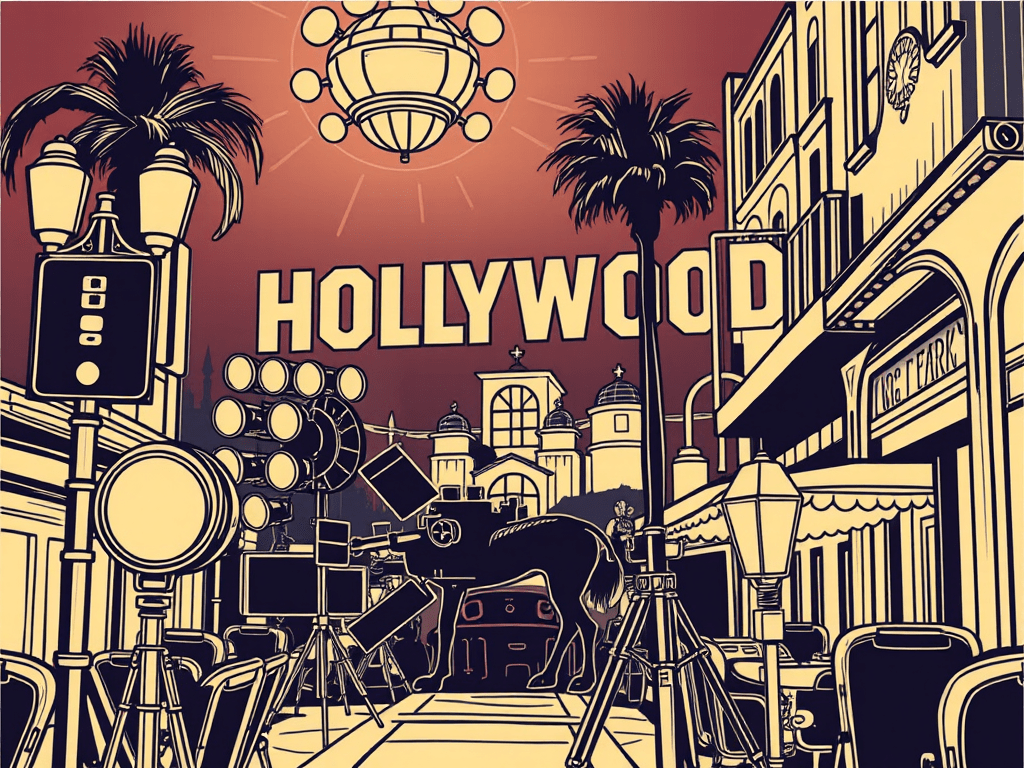
Hollywood has changed dramatically, in obvious ways to those old enough to remember the old system. Stars used to be marketed as gods, their words uniquely valuable, their images curated completely. Now it’s different. The internet makes controlling an image impossible, competition from social media, news, and unlimited streaming means only a handful of stars can be marketed to everyone, and even then, they remain stars that started out before the era of fragmentation. Conspiracy theories nip at the margins — what was all that marketing covering up, exactly? And we’ve started to question the overarching narratives that we absorbed.
“Forever Young” (YouTube) – I’ve watched this video many times; it feels like lifetimes ago. Yet the people are still stars today. It’s because all the money spent branding these actors can’t be replicated in a fragmented ecosystem, so they’re still marketable.
George Clooney on Hollywood “elites” (X) – Plenty of conspiracy theories exist; here’s a grounded take.
We’ve all been raised by evil love stories – Be careful what you consume.
-
In his book Sapiens, Yuval Noah Harari says that symbols tie cultures together. Without them, we couldn’t unite into nations and tribes. Money is a symbol, national identity is a symbol, brands and institutions are a symbol. Symbols therefore are important, and the digital world rushes over us with new symbols and destroys old symbols. What does this mean?
Don’t get lost in the world of signs (X). – Want to avoid getting lost? Here is a very practical (and very short) strategy.
Things are getting weird (X) – Where is this all going and where is it going to go?
My review of Superman – the symbol is as important as the movie.
-

“the curve we’ve been riding just flattened into a long plateau.”(X) – a sensible look at what physics and energy teaches us about the future of AI.
“What would a human pretending to be an AI say?” Interesting read on the language used by chatbots, and how it is based on human language. “AIs are trained to predict the training data, not to learn unrelated abilities, so we should expect an AI asked to predict the thoughts of an AI to describe the thoughts of a human pretending to be an AI.”
“ChatGPT and the meaning of life” – a philosopher’s thoughts on a future of life without work, and what it means – both good and bad. “Grief, you don’t need me to tell you, is a complicated beast. You can grieve for something even when you know that, on balance, it’s good that it’s gone.”
-
Reading Wikipedia articles from other countries is a good way to escape local bias, because other countries lack the incentives to prop up narratives. French Wikipedia paints the American Revolution as a violent and treasonous riot that started when Britain required the colonies to pay for their own defense:
The American Revolution is a period of political changes after 1763 in the thirteen British colonies of North America, which gave rise to the American War of Independence against Great Britain, with the help of France. The founding episode of the American nation and the birth of the United States, the revolution was manifested by violence against the British authorities, a war against English troops and social unrest.
More here, and once it adds foreign languages, Grokipedia will likely be the same.
-

The comic book writer Grant Morrison understood that if you get to tell a Superman story, you’ve been entrusted with global symbols of justice and kindness and goodness which are important to people. He understood this power, and when he had the opportunity to write Superman, he bucked every existing trend (and his own ouevre), returning Superman to the ultimate paragon of virtue.
Like Grant Morrison, James Gunn understands the power of the Superman symbol. He treats this symbol with respect for its power to elevate others, creating a movie where Superman understands that— in his own words — kindness is punk rock. Kindness is the true act of defiance against a cynical, treacherous world.
Zach Snyder most definitely did not get it. He tarnished the symbol, creating a darker Superman for reasons that never made sense, were never entertaining, and which wasted the talents of Henry Cavill. So it’s refreshing to see – and hope – that this marks a return to symbols and a franchise that inspires rather than drains, that shows real people rather than marketable archetypes, and that stands on its own morality rather than mirroring whatever is most politically advantageous at any given moment.
More: The cameos are extraordinary, the actors playing Lex Luthor and Mr. Terrific turn in amazing, super watchable, A+ work. James Gunn makes Hawkgirl a badass, dials Guy Gardner up to ten, treats Lois Lane like the competent professional she is, and keeps Jimmy Olsen interesting. And in an amazing, beautiful detail, James Gunn makes Clark’s parents real, not flannel-wearing Abercrombie models. They’re normal, they’re pre-diabetic, and they’re not gorgeous or eloquent or filled with endless reservoirs of wisdom — what they are is honest and good and they hold Clark to the highest standards, expecting him to meet those standards of human decency no matter how powerful he is.
Are there plot holes? Yes, totally. Could the script use a little more tightening? Yep. Do the fight scenes need a bit more tension? Sure. But no one cares, because this is fun, it heals through inspiration and man oh man does it set up the potential for a great DC Universe. Marvel better watch out.
-
As Scott Adams says, our brains were not built to understand reality, our brains evolved for reproduction. Human brains don’t innately understand statistics and are designed for storytelling. People with widely different views (a Catholic and a Buddhist, say) can hang out together with no problem. In short, we don’t have a strong model on reality. So how can we tell who has the best model?
The only real way is to bet on it. Ask someone to make predictions, and see how good they are at making them. This gives you a better way to test someone’s model of reality than the story they tell you.
The website Kalshi allows you to track global predictions. Over time, presumably, we’ll learn just how good a wide number of thinkers who need to put actual money on the line are at understanding consensus reality. This may potentially allow you to “predict the future” based on current predictions by people with strong, proven maps of how reality actually is. We’ll also see if bad actors can manipulate reality by contributing heavily to prediction markets in their favor.
This is regulated, institutional-grade infrastructure for trading reality itself. Building on the foundation that Polymarket established globally, Kalshi brings prediction markets into the regulated US financial system.
It will remain to be seen, but if the predictions match the future, we might be seeing the best tool we have for predicting the future.
-
I’ve come to accept that we all live in information bubbles, that it’s hard to pierce those bubbles, and that it’s helpful when we get a chance to see outside our realities. But unfortunately, piercing through what we know is often a very painful experience.
One obstacle is that people get judgmental about people not like them. You hear this when people with money say that poor people should work harder or when poor people say the rich are all callous. The world outside always looks different.
Another obstacle is that the best way to get out of our information bubbles is to be kicked out of them, and that is exceedingly painful and not something I recommend. But occasionally a well-written, non-judgmental piece gives us the opportunity to widen our understanding, and when that happens, I think it’s good to pause for a moment and take the opportunity, because it’s better for everyone when people widen their information environments. So here are two excellent articles, and they’re eye-opening and a reminder don’t take anything for granted:
“Being poor” “Being poor is going to the restroom before you get in the school lunch line so your friends will be ahead of you and won’t hear you say “I get free lunch” when you get to the cashier.”
“secretly poor” “I’ve invented headaches to beg off from dinners with friends at restaurants and broken water pipes to cover the fact that sometimes I can’t afford to host people at my place.”

