In my early twenties I worked in a Milwaukee call center, processing credit card complaints. Customers complained to an India team first. If that team couldn’t resolve the problem, they escalated it to the Milwaukee center, where we resolved it.
All the Milwaukee reps sat in a large open room of cubicles, logging in promptly to start our shifts, where I put on my headset and logged into dashboard software giving me information about the incoming caller. The managers sat at the edge of the room, in taller cubicles, where they listened to our calls to monitor the quality of our customer service and ensure we were hitting our timelines for resolving issues.
It felt like a dead-end job, and I’m supposed to say I hated it. But the truth is, I really enjoyed the work. All day long I fielded calls from people all over the United States, and since pretty much everyone has a credit card, I talked to people from all walks of life, living in places I’d never visited, and listened to their stories while resolving their issues.
I met people from India, too. I’d talk to them when they transferred calls, or to follow up. I got to know a few of them. They all worked in a city called Bangalore. We shared stories with each other – they asked about life in the United States, and I asked them about their lives and about Bangalore and what it’s like living there.
Living in Milwaukee, making very little money, Bangalore felt impossibly remote, like an outpost at the absolute edge of the earth. I would go home to my small apartment, filled with cigarette smoke and my papers everywhere, and imagine Bangalore as a place of broad avenues, gardens and open campuses. I read stories of Americans who traveled there to build businesses, but I certainly never expected to visit.
Yet life follows funny patterns. Recently I visited Bangalore for work. I’d long since forgotten about that time in Milwaukee, but being here the memories flooded back, and sitting here typing from a wood-paneled Bangalore suite, I recognize that I’ve been true to my 24-year old self. My past self would be thrilled to see me here now, fulfilling the dreams of a frustrated 24 year old who wasn’t sure where they were going in life.
Bangalore (now called Bengalaru) is more than I imagined at 24. It’s India’s Silicon Valley, which started in 1985 when Texas Instruments laid a revolutionary satellite link allowing Bengaluru engineers to commit code directly to Dallas. Since then the city has grown from a Chicago-sized city of 3 million to today’s total of 13 million people.
40% of India’s venture capital circulates in Bengalaru, and the city’s workers drive success at the world’s largest IT firms. Out my hotel window I can see skyscrapers for Wipro and IBM. Driving through the city I’ve seen skyscrapers for Capgemini, Deloitte and Adobe. Pride in innovation is everywhere – the food court across the street is decorated with images of tech leaders – Satya Nadella, Mark Zuckerberg, Bill Gates, Elon Musk.
My hotel is in a neighborhood called Whitefield that has its own story. Whitefield started as a utopian social experiment in the 1880s. An Anglo-Indian named David Emmanuel Starkenburgh White wanted to create a village where no one owned property and everyone worked for the common good, so he built a 3,900 acre farming community of concentric circles around a central Village Green, calling it Whitefield.
This utopian experiment was so remote that visitors needed to write to one of White’s relatives to hire a cart from the railway station, arriving at an overgrown village green filled with jackals and hyenas. Unfortunately this utopian dream didn’t work, although there’s a longstanding legend that Winston Churchill arrived at the Whitefield Inn to court the innkeeper’s daughter when he was stationed in Bangalore.
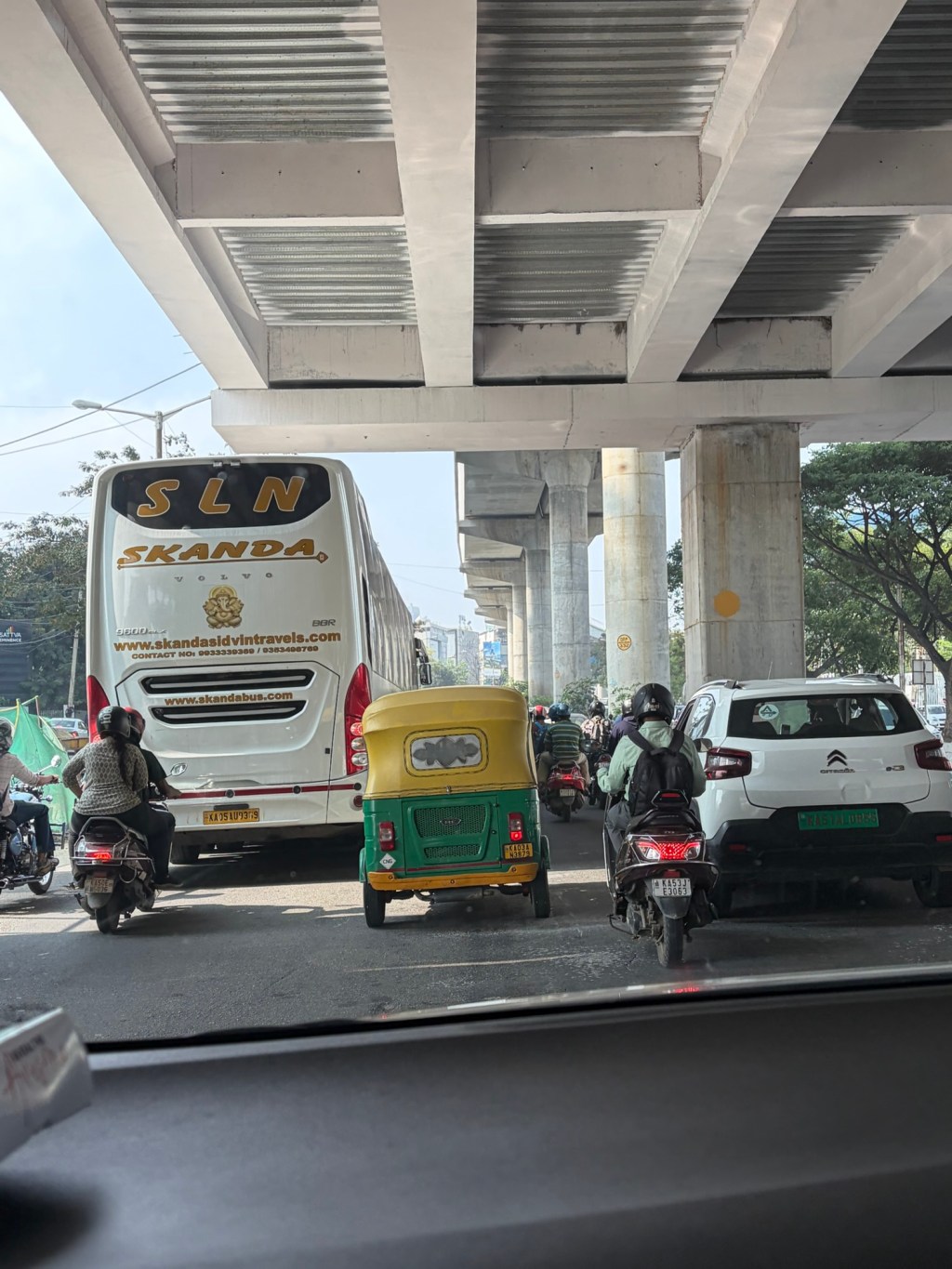
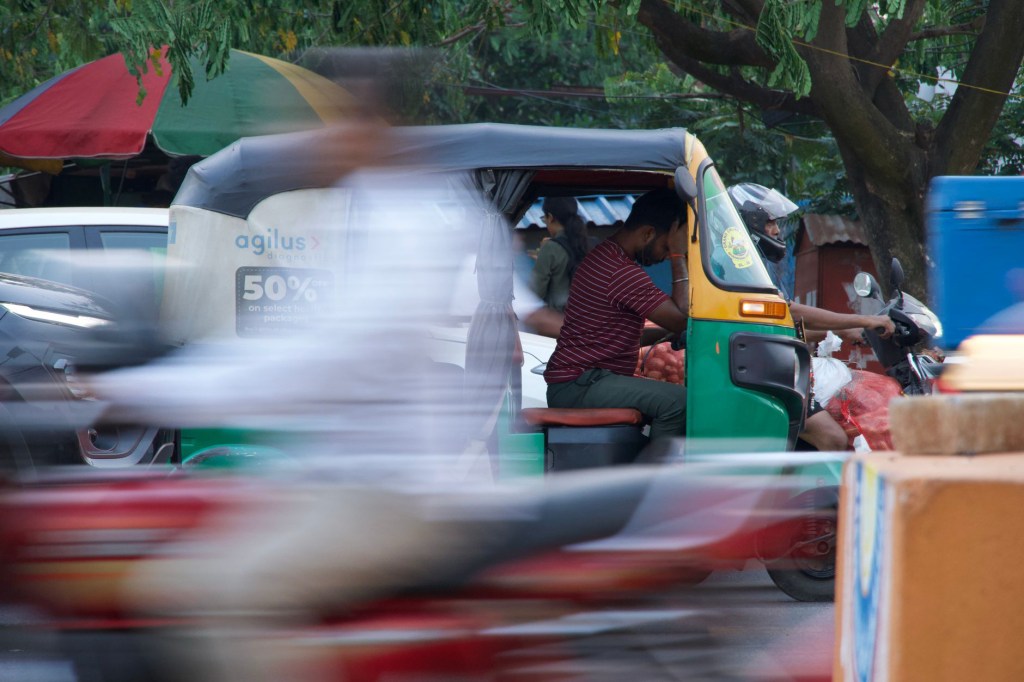
Today, that failed utopian village has grown 2600x, becoming an area of 300,000 people filled with tech offices and residences, a far cry from its original layout. Since my hotel was in Whitefield, I traveled from there to another office park, which meant navigating Bengaluru’s legendary traffic. Everywhere I went, people talked about Bengaluru traffic because there’s simply no way around it – Bengaluru is ranked the second most challenging city in the world for traffic and while here, I saw things on the road I’ve never seen before.
Motorcycles routinely drove the wrong way on roads. They merged close enough to breathe on the car I was in. People fit a car and two motorcycles in one lane. I saw three cows wander across the street in the middle of traffic as well as dogs, and of course, people.
Stores, restaurants and apartments stacked right up against the road, separated only by a narrow sidewalk, and all this resolved into a maze of alleys hidden from view of the street. The traffic, the people, and the commerce combined into one, single experience navigated on a simple trip to a nearby office park. I think driving here would be impossible if you didn’t understand the rules.
And there are rules. I had lunch with an engineer who works on AI for car software and talked to him about the traffic. He said there are unwritten rules of the road and communication between drivers, but as a foreigner, I didn’t see it. He added that he thinks making self-driving cars for Bengalaru would be an unbelievably difficult engineering challenge.
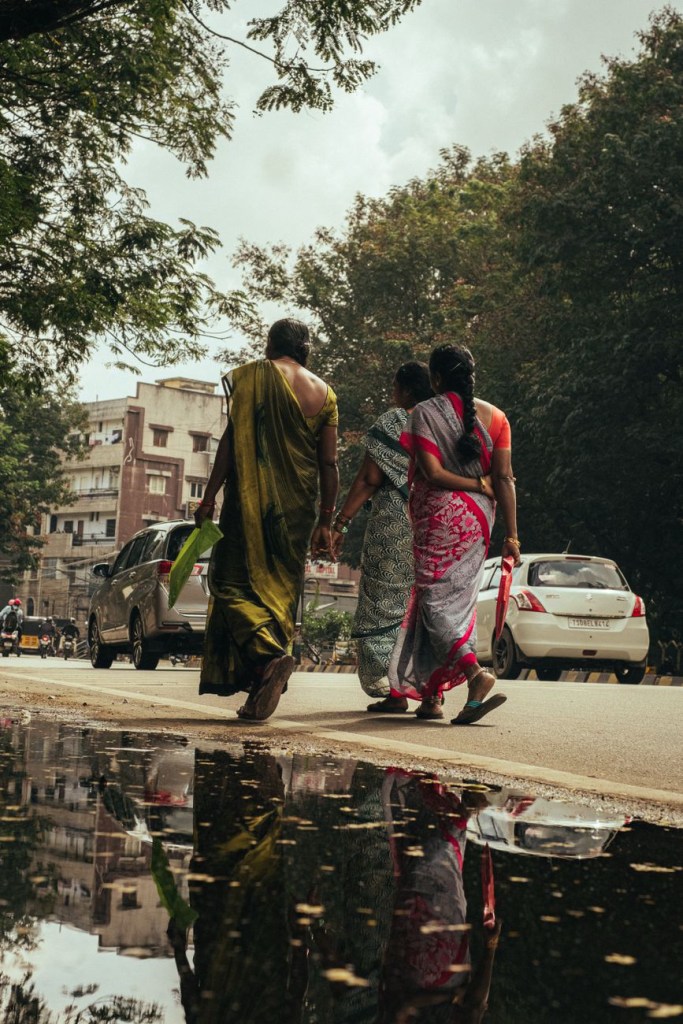
What an amazing, wonderful city. The people were smart, they were wonderful to talk with, the food was delicious – bowls of seasoned rice and curries – and I left very grateful. My 24-year old self would be proud that I visited the city of all those customer service representatives I met decades ago, never imagining that one day I would get the opportunity to visit.
When I lived in Milwaukee, I was lost. I couldn’t see my future ahead of me, and felt trapped in my small apartment watching my friends do what seemed to be bigger and better things than me. But I always looked ahead, always thinking I could do better.
Sitting here now, in front of a window overlooking Bengaluru, I’m reminded that life is many moments, it’s not just a single point of time. When it seems like the future is cloudy, that just means it’s cloudy – it doesn’t necessarily mean that there isn’t something different out there in front of the dark clouds. I count myself fortunate to be in Bangalore, and if I could go back in time, I would tell my 24 year-old self to keep believing in the future, keep being grateful for what’s around you, and keep driving forward.


Leave a Reply